Question Paper & Detailed Solutions
Complete 100 MCQs with Step-by-Step Derivations
Comprehensive solved question paper with authentic official KEA key answers, diagrams, mathematical explanations, and syllabus categorization.
📋 Table of Contents
Section 1: Mathematics
📝 Solution
Explanation: It correctly lists the elements located exactly on the main diagonal from top-left to bottom-right.
Step-by-step:
The principal diagonal elements of a square matrix are the elements $a_{ij}$ where the row index $i$ is equal to the column index $j$. • Identify element $a_{11}$ (Row 1, Column 1): 1 • Identify element $a_{22}$ (Row 2, Column 2): 5 • Identify element $a_{33}$ (Row 3, Column 3): 9 • Final Simplification: 1, 5, 9
📝 Solution
Explanation: The expansion of the matrix simplifies into the fundamental trigonometric identity $\cos^2 x + \sin^2 x$, which equals 1.
Step-by-step:
$$ \Delta = a_{31}C_{31} + a_{32}C_{32} + a_{33}C_{33} $$ Expand along the 3rd row: $$ \Delta = 0 - 0 + 1 \begin{vmatrix} \cos x & -\sin x \ \sin x & \cos x \end{vmatrix} $$ $$ \Delta = 1 \cdot [(\cos x \cdot \cos x) - (\sin x \cdot -\sin x)] $$ $$ \Delta = \cos^2 x - (-\sin^2 x) = \cos^2 x + \sin^2 x $$ $$ \Delta = 1 $$
📝 Solution
Explanation: According to the fundamental theorems of matrix algebra, if $A$ is any square matrix, multiplying $A$ by its adjoint matrix always yields a scalar matrix where every element on the principal diagonal is equal to the determinant of $A$. Mathematically: $A(\text{adj } A) = (\text{adj } A)A = |A|I$.
Step-by-step:
By the fundamental theorem of matrix algebra, multiplying a square matrix by its adjoint matrix results in a scalar matrix.
The diagonal elements of this resulting matrix are equal to the determinant of $A$ (i.e., $|A|$), and all off-diagonal elements are 0.
Therefore, $A \cdot \text{adj}(A) = |A| \cdot I$, where $I$ is the identity matrix.
📝 Solution
Explanation: Step-by-step determinant calculations of the respective $2 \times 2$ sub- matrices yield exactly -42 and -19.
Step-by-step:
Minor of 5 (Position $a_{21}$): Delete Row 2 and Column 1. $$ M_{21} = \begin{vmatrix} -2 & 4 \ 6 & 9 \end{vmatrix} = (-2 \times 9) - (4 \times 6) = -18 - 24 = -42 $$ Minor of 2 (Position $a_{22}$): Delete Row 2 and Column 2. $$ M_{22} = \begin{vmatrix} 1 & 4 \ 7 & 9 \end{vmatrix} = (1 \times 9) - (4 \times 7) = 9 - 28 = -19 $$
📝 Solution
Explanation: Direct algebraic substitution and transposing the constant yields -3.
Step-by-step:
If a point lies on a given line, substituting its coordinates must satisfy the equation. $$ (1) + (2) + \lambda = 0 $$ $$ 3 + \lambda = 0 $$ $$ \lambda = -3 $$
📝 Solution
Explanation: Isolating $y$ yields a positive coefficient of 3/4 for $x$, which is the slope.
Step-by-step:
Rearrange the equation into slope-intercept form ($y = mx + c$). $$ 4y = 3x + 7 $$ $$ y = \frac{3}{4}x + \frac{7}{4} $$ Identify the value occupying the $m$ position (coefficient of $x$). $m = \frac{3}{4}$
📝 Solution
Explanation: $\tan(90^\circ)$ evaluates to infinity, which perfectly matches the behavior of a vertical line.
Step-by-step:
The slope ($m$) of a straight line is $m = \tan \theta$. A line parallel to the Y-axis is perfectly vertical ($\theta = 90^\circ$). $$ m = \tan(90^\circ) = \infty $$
📝 Solution
Explanation: Applies the derived slope of -1 and the positive intercept, matching the final algebraic form.
Step-by-step:
Calculate the slope $m = \tan(135^\circ) = \tan(180^\circ - 45^\circ) = -\tan(45^\circ) = -1$. Substitute $m = -1$ and intercept $c = 4$ into $y = mx + c$: $$ y = -1x + 4 $$ Rearrange into standard format ($Ax + By + C = 0$): $$ x + y - 4 = 0 $$
📝 Solution
Explanation: Applying the chain rule correctly results in the double negative canceling out, yielding a positive numerator.
Step-by-step:
Rewrite fraction using negative exponents: $y = 2(1 - x)^{-1}$ Apply chain rule: $$ \frac{dy}{dx} = 2 \cdot (-1)(1 - x)^{-2} \cdot \frac{d}{dx}(1 - x) $$ $$ \frac{dy}{dx} = -2(1 - x)^{-2} \cdot (-1) $$ $$ \frac{dy}{dx} = 2(1 - x)^{-2} = \frac{2}{(1 - x)^2} $$
📝 Solution
Explanation: The expansion perfectly matches the mathematical outcome of applying the product rule.
Step-by-step:
Use Product Rule: $\frac{d}{dx}(uv) = u\frac{dv}{dx} + v\frac{du}{dx}$ Let $u = e^x$, $v = \cos x$. $$ \frac{du}{dx} = e^x $$ $$ \frac{dv}{dx} = - \sin x $$ $$ \frac{dy}{dx} = (e^x)(-\sin x) + (\cos x)(e^x) $$ $$ \frac{dy}{dx} = e^x(-\sin x + \cos x) $$
📝 Solution
Explanation: Applying the chain rule for exponential derivatives twice and substituting $x=0$ yields exactly 34.
Step-by-step:
First derivative: $$ \frac{dy}{dx} = 3e^{3x} - 5e^{-5x} $$ Second derivative: $$ \frac{d^2y}{dx^2} = 9e^{3x} + 25e^{-5x} $$ Substitute $x = 0$: $$ \frac{d^2y}{dx^2} = 9e^0 + 25e^0 = 9(1) + 25(1) = 34 $$
📝 Solution
Explanation: The derivative of the area formula $\pi r^2$ directly yields $2\pi r$, geometrically representing the circumference.
Step-by-step:
Area of a circle: $A = \pi r^2$ Differentiate $A$ with respect to $r$: $$ \frac{dA}{dr} = \pi \cdot \frac{d}{dr}(r^2) = \pi \cdot 2r = 2\pi r $$
📝 Solution
Explanation: Matches each function exactly to its universally accepted standard calculus integration formula.
Step-by-step:
• (a) $\int e^x dx = e^x + c \rightarrow$ (ii) • (b) $\int \frac{1}{x} dx = \log x + c \rightarrow$ (i) • (c) $\int dx = x + c \rightarrow$ (iv) • (d) $\int \sec^2 x dx = \tan x + c \rightarrow$ (iii)
📝 Solution
Explanation: Applying the substitution method correctly evaluates the power rule onto the $\sin x$ term.
Step-by-step:
Let $u = \sin x$, then $du = \cos x \cdot dx$. Substitute $u$ and $du$ into the integral: $$ \int u^6 \cdot du = \frac{u^7}{7} + c $$ Substitute $u = \sin x$ back: $$ \frac{\sin^7 x}{7} + c $$
📝 Solution
Explanation: Correctly applies the integration by parts rule and properly handles the double negative.
Step-by-step:
Integration by Parts: $\int u \cdot dv = u \cdot v - \int v \cdot du$ Let $u = x$, $dv = \cos x \cdot dx$ $du = dx$, $v = \sin x$ $$ \int x \cos x \cdot dx = x(\sin x) - \int \sin x \cdot dx $$ $$ = x \sin x - (-\cos x) + c = x \sin x + \cos x + c $$
📝 Solution
Explanation: The definite integration strictly yields 59/6, which is multiplied by $\pi$ according to the volume formula.
Step-by-step:
$$ V = \pi \int_{1}^{2} y^2 dx = \pi \int_{1}^{2} (x^2 + 5x) dx $$ $$ \int (x^2 + 5x) dx = \left[ \frac{x^3}{3} + \frac{5x^2}{2} \right]_{1}^{2} $$ Upper Limit ($x=2$): $\frac{8}{3} + 10 = \frac{38}{3}$ Lower Limit ($x=1$): $\frac{1}{3} + \frac{5}{2} = \frac{17}{6}$ $$ V = \pi \left(\frac{38}{3} - \frac{17}{6}\right) = \pi \left(\frac{76}{6} - \frac{17}{6}\right) = \frac{59\pi}{6} $$
📝 Solution
Explanation: $480^\circ$ co-terminates with $120^\circ$. Sine in the second quadrant is positive.
Step-by-step:
$$ \sin(480^\circ) = \sin(360^\circ + 120^\circ) = \sin(120^\circ) $$ Angle $120^\circ$ is in the second quadrant where sine is positive. $$ \sin(180^\circ - 60^\circ) = \sin(60^\circ) = \frac{\sqrt{3}}{2} $$
📝 Solution
Explanation: The expansion of the sine of a sum of two angles distributes the sine and cosine functions across both angles while maintaining the positive sign.
Step-by-step:
Recall the fundamental compound angle identity for sine:
$\sin(A + B) = \sin A \cdot \cos B + \cos A \cdot \sin B$.
This distributes the sine and cosine functions across the two angles.
📝 Solution
Explanation: Applying the $\cos(A-B)$ identity and solving the Pythagorean triplets correctly yields $63/65$.
Step-by-step:
$$ \cos(A - B) = \cos A \cos B + \sin A \sin B $$ $$ \sin A = \sqrt{1 - (12/13)^2} = 5/13 $$ $$ \cos B = \sqrt{1 - (3/5)^2} = 4/5 $$ $$ \cos(A - B) = \left(\frac{12}{13}\right)\left(\frac{4}{5}\right) + \left(\frac{5}{13}\right)\left(\frac{3}{5}\right) = \frac{48}{65} + \frac{15}{65} = \frac{63}{65} $$
📝 Solution
Explanation: Proper trigonometric reduction via supplementary and complementary angles converts the expression to $\cos^2 35^\circ$.
Step-by-step:
$$ \sin(125^\circ) = \sin(180^\circ - 55^\circ) = \sin 55^\circ $$ Expression becomes: $\sin 55^\circ \cdot \sin 55^\circ = \sin^2 55^\circ$ Apply complementary angle: $\sin 55^\circ = \cos(90^\circ - 55^\circ) = \cos 35^\circ$ $$ \sin^2 55^\circ = \cos^2 35^\circ $$
Section 2: Statistics
📝 Solution
Explanation: A Box-Plot is a standardized statistical graph used to display the distribution of data based on a five-number summary: minimum, first quartile (Q1), median (Q2), third quartile (Q3), and maximum.
Step-by-step:
A Box-Plot (or box-and-whisker plot) is specifically designed to display the five-number summary of a dataset: minimum, first quartile (Q1), median (Q2), third quartile (Q3), and maximum.
A Leaf-Plot (Stem-and-Leaf) shows individual data points.
A Line-Plot displays data points connected by line segments, usually over time.
A Pie-Chart shows categorical data as proportional slices.
📝 Solution
Explanation: A histogram is a graphical representation of grouped continuous frequency distributions. The horizontal axis width corresponds strictly to the class interval, and the vertical height corresponds to frequency.
Step-by-step:
A histogram is used for continuous quantitative data (eliminating Options 1 and 4, which are for categorical/qualitative data).
The visual structure of a histogram consists of adjoining rectangular bars.
The horizontal width of each bar represents the class interval (or bin size).
The vertical height of each bar represents the frequency or relative frequency of the data falling within that interval.
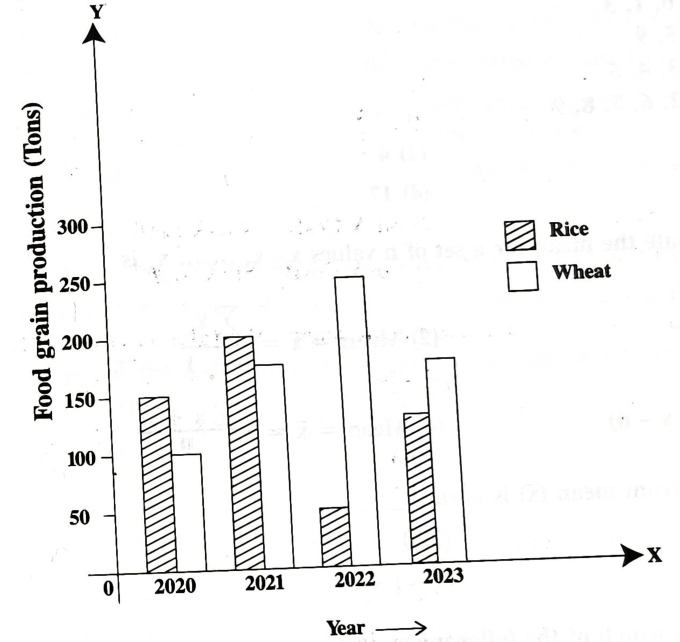
📝 Solution
Explanation: Based on reading the height of the bars directly from the graph, Rice exceeds Wheat strictly in 2021 and 2022. (Note:
Step-by-step:
Identify the legend: Rice is the shaded bar, Wheat is the blank (white) bar.
Analyze 2020: Rice (~150) < Wheat (~200).
Analyze 2021: Rice (~200) > Wheat (~100). (Rice is more).
Analyze 2022: Rice (~250) > Wheat (~150). (Rice is more).
Analyze 2023: Rice (~100) < Wheat (~150).
📝 Solution
Explanation: The blank bars for 2022 and 2023 are visually and numerically equal. (Note:
Step-by-step:
2020 Wheat = 200, 2021 Wheat = 100, 2022 Wheat = 150, 2023 Wheat = 150. $2022 \text{ Wheat} = 2023 \text{ Wheat} = 150$
📝 Solution
Explanation: In a stem-and-leaf plot, each individual digit on the "leaf" side represents one individual data point.
Step-by-step:
Count the number of leaves for Stem 1: 4 leaves (2, 4, 5, 7).
Count the leaves for Stem 2: 3 leaves (0, 1, 3).
Count the leaves for Stem 3: 2 leaves (5, 9).
Count the leaves for Stem 4: 3 leaves (3, 4, 5).
Count the leaves for Stem 5: 5 leaves (2, 6, 7, 8, 9).
Total leaves = .
📝 Solution
Explanation: The arithmetic mean is fundamentally defined as the sum of all individual observations divided by the total number of observations.
Step-by-step:
The arithmetic mean is defined as the sum of all observations divided by the total number of observations.
Sum of observations is mathematically denoted by .
Total number of observations is .
Therefore, .
📝 Solution
Explanation: Mathematical proof demonstrates that the sum of the differences between each data point and the mean perfectly cancel each other out.
Step-by-step:
$$ \sum (x_i - \bar{x}) = \sum x_i - \sum \bar{x} = n\bar{x} - n\bar{x} = 0 $$
📝 Solution
Explanation: Statement A is true (one unique mean). Statement B is true (median is positional, unaffected by extreme ends). Statement C is false (mode is not affected by extreme values).
Step-by-step:
Analyze Statement A: A dataset has exactly one arithmetic mean. It is uniquely defined. (True).
Analyze Statement B: The median is merely the positional middle value when sorted. Changing the actual numerical value of the largest or smallest number does not change the median. Therefore, its value does not depend on all exact observations. (True).
Analyze Statement C: Mode is the most frequently occurring value. A sudden extreme outlier (e.g., changing a 10 to a 1000) does not change the frequency of the other numbers, so mode is not affected by extreme values. (False).
📝 Solution
Explanation: Quartile Deviation is strictly defined as half of the Interquartile Range ($Q_3 - Q_1$).
Step-by-step:
The Interquartile Range (IQR) measures the spread of the middle 50% of data and is defined as .
The Quartile Deviation is half of the Interquartile Range.
Therefore, .
📝 Solution
Explanation: Range $\rightarrow$ Difference (iii). Mean $\rightarrow$ Average (iv). Mode $\rightarrow$ Most repeated (ii). Median $\rightarrow$ Middle number (i). Official Key Answer: Option (3)
Step-by-step:
Range = Max - Min (Difference between largest and smallest). So, a iii.
Mean = Average of all observations. So, b iv.
Mode = Most frequently occurring (repeated) value. So, c ii.
Median = The strict middle positional value. So, d i.
Combine the matches: a-iii, b-iv, c-ii, d-i.
Section 3: Programming
📝 Solution
Explanation: Loops are a core part of the programming language syntax, not an imported package for scientific computing.
Step-by-step:
Numpy is a core library for numerical computing (arrays/matrices).
Matplotlib is a library for plotting and data visualization.
Pandas is a library for data manipulation and analysis.
Loops (like for and while) are fundamental control flow structures built into the Python language itself, not an external package or library.
📝 Solution
Explanation: Python relies strictly on leading whitespace (indentation) to determine the grouping of statements and define code blocks.
Step-by-step:
In languages like C, C++, or Java, blocks of code (like what belongs inside an if statement or a loop) are enclosed in curly braces {}.
Python was designed for high readability and discards curly braces.
Instead, Python uses leading whitespace (indentation) to explicitly define the scope and grouping of statements.
📝 Solution
Explanation: "Nested" is the formal computer science terminology for placing one control structure inside another.
Step-by-step:
A loop running its own iterations inside the block of another loop is a standard programming construct.
The universal computer science term for this architecture is a "Nested loop".
Since "Nested for loop" is the only option presenting the term "Nested", it is the most accurate specific description provided.
📝 Solution
Explanation: Following standard mathematical order of operations and applying the modulo correctly gives a remainder of 1.
Step-by-step:
$5^3 = 125$. Add 8 = 133. $133 \pmod 2 = 1$.
📝 Solution
Explanation: 20 $\rightarrow$ Integer. "Text" $\rightarrow$ String. 12.5 $\rightarrow$ Float. 3.0+4.1j $\rightarrow$ Complex.
Step-by-step:
a = 20 is a whole number without a decimal point. This is an int (Integer). (a ii)
b = "Hello Python" is text enclosed in quotation marks. This is a str (String). (b iii)
c = 12.5 is a number containing a decimal point. This is a float. (c iv)
d = 3.0 + 4.1j contains a real part and an imaginary part (denoted by j in Python). This is complex. (d i)
Correct combination: a-ii, b-iii, c-iv, d-i.
📝 Solution
Explanation: The if condition is false, so the flow logically routes directly to the else block.
Step-by-step:
$x=0$. Condition 0 == 1 is False. Execution goes to else, printing "B".
📝 Solution
Explanation: Since "number of students" involves numerical counting, it is Quantitative. You cannot have fractional students, so it must be Discrete.
Step-by-step:
Quantitative vs Qualitative: A "number of students" is a measurable amount, meaning it is numerical/Quantitative. It is not a descriptive category (Qualitative).
Discrete vs Continuous: You can only have whole students (e.g., 40, 41, 42). You cannot have 40.5 students. Data that can only take specific, distinct integer values is "Discrete". Continuous data can be any decimal on a scale (like height or weight).
📝 Solution
Explanation: The digital, automated nature of cloud-based forms like Google Forms makes them objectively faster than any manual or face-to-face method.
Step-by-step:
Data collection speed is evaluated by how quickly one can reach respondents and aggregate the results.
Face-to-face methods like Interviews and Group discussions require scheduling, physical presence, and manual transcribing. They are very slow.
Traditional paper surveys require physical distribution and manual data entry.
A Google Form survey is electronic. It can be distributed instantly to thousands of people worldwide via a single link, and the platform automatically aggregates and tabulates the responses in real-time.
📝 Solution
Explanation: Height $\rightarrow$ Continuous. Number of teachers $\rightarrow$ Discrete. Aadhar $\rightarrow$ Nominal. Grades $\rightarrow$ Ordinal. Sequence: a-ii, b-iv, c-i, d-iii.
Step-by-step:
Height of a person: Can be exactly 170.5 cm, 170.55 cm, etc. It spans an infinite range of decimals. Therefore, Continuous data. (a ii)
Number of teachers: Must be a whole number count (e.g., 25). Therefore, Discrete data. (b iv)
Aadhar Number: Even though it consists of numbers, it is just a label or an ID tag. It holds no numeric weight (a higher Aadhar number doesn't mean a "better" citizen). Therefore, Nominal data. (c i)
Student grades: Letters like A, B, C, D imply an inherent ranking or order (A is better than B), but the distance between them isn't mathematically quantified. Therefore, Ordinal data. (d iii)
Correct Sequence: a-ii, b-iv, c-i, d-iii.
📝 Solution
Explanation: "Classification" is the precise academic term used for grouping data based on similarities and characteristics.
Step-by-step:
When raw data is collected, it is a jumbled mass.
The specific act of dividing this data into different homogenous classes or groups based on shared attributes/characteristics (like grouping people by age brackets, or cars by manufacturer) is strictly defined as Classification.
Organization is the broader term that includes classification and sorting. Tabulation is specifically putting classified data into rows and columns. Presentation refers to charting or graphing.
📝 Solution
Explanation: The value 135 is printed, and a updates to 126 in memory afterward.
Step-by-step:
Because ++ is a post-increment operator, the current value of a (125) is used for the addition before incrementing. $10 + 125 = 135$.
📝 Solution
Explanation: "abcd" contains only valid alphabetic characters and starts with a letter, making it a perfectly valid identifier. The others use illegal symbols or start with numbers.
Step-by-step:
Rule 1: Identifiers must start with a letter (a-z, A-Z) or an underscore _.
Rule 2: They cannot start with a digit.
Rule 3: They cannot contain special characters like @, $, /, -.
Evaluating the options:
$abcd starts with $ (Invalid).
12_34a starts with a digit (Invalid).
/M_ab starts with / (Invalid).
abcd consists entirely of valid letters (Valid).
Section 4: Computer Science
📝 Solution
Explanation: Parallelogram $\rightarrow$ Input/Output. Diamond $\rightarrow$ Decision. Double-line Rectangle $\rightarrow$ Predefined processing. Rectangle $\rightarrow$ Processing.
Step-by-step:
Parallelogram (a): Universally used to denote an Input or Output operation. (a i)
Diamond (b): Represents a conditional Decision point (Yes/No branches). (b iv)
Rectangle with double vertical lines (c): Denotes a Predefined Process or a Subroutine. (c ii)
Rectangle (d): Represents standard Process / Computer Processing step. (d iii)
The resulting sequence is a-i, b-iv, c-ii, d-iii.
Section 5: Web Technologies
📝 Solution
Explanation: "Communication" is a generic computing concept, not a distinct, programmable architectural component class within the Android OS SDK.
Step-by-step:
The primary structural components of an Android App are: Activities, Services, Broadcast Receivers, and Content Providers.
The Application class is also a fundamental base class in Android that maintains global application state.
"Communication" is a general concept (like networking or IPC), but it is not the name of an Android architectural component class.
📝 Solution
Explanation: Flawlessly pairs frontend CSS styling syntax with the exact rendering behavior (Padding=inside, Margin=outside, Z-index=stack, Opacity=transparency).
Step-by-step:
Padding (a): Defines the space inside the border, pushing the content inward. (a ii)
Margin (b): Defines the space outside the border, pushing other elements away. (b iii)
Z-index (c): Determines which elements overlap others (vertical stacking/depth). (c iv)
Opacity (d): Determines how see-through/transparent an element is. (d i)
The sequence is a-ii, b-iii, c-iv, d-i.
📝 Solution
Explanation: Rendering HTML code into a visible graphical webpage is the primary, defining function of a web browser.
Step-by-step:
HTML (HyperText Markup Language) is plain text code that dictates the structure of a webpage.
A Web browser (like Chrome, Firefox, Safari) is the client-side software specifically engineered to parse this HTML code and "render" it into the graphical layout you see on screen.
Servers store/send the files, OS manages the hardware, and Databases store dynamic data.
📝 Solution
Explanation: The pop() method acts exactly like a stack data structure pop operation, specifically removing the tail (last) element.
Step-by-step:
Arrays in JavaScript function similarly to stacks.
The pop() method specifically removes the last element from an array and returns that element.
The shift() method removes the first element.
slice() and splice() are used for extracting or replacing middle sections of an array.
📝 Solution
Explanation: User clicks (c) $\rightarrow$ JS validates (a) $\rightarrow$ Browser sends request (b) $\rightarrow$ Server responds (d).
Step-by-step:
The process initiates when the User clicks submit (c).
Before the browser sends anything over the network, it runs Client-side Form Validation (a) using HTML5/JavaScript to ensure fields aren't empty.
If validation passes, the browser constructs and sends the HTTP Request (b) (e.g., a POST request) to the server.
The server processes the data and sends back a Server Response or Redirect (d) (e.g., "Thank you" page).
Correct chronological sequence: c a b d.
📝 Solution
Explanation: Correctly maps standard corporate departments to their primary operational duties within an ERP framework.
Step-by-step:
Marketing and sales (a): Handles advertising, selling, and marketing a product (iii). (a iii)
Accounting and Finance (b): Handles financial accounting of payments (iv). (b iv)
Human Resources (c): Handles recruiting and hiring personnel (ii). (c ii)
Supply chain management (d): Handles logistics, purchasing goods, and materials (i). (d i)
The combined sequence is a-iii, b-iv, c-ii, d-i.
📝 Solution
Explanation: The HRM module is specifically built to centralize all employee-related data and automate payroll processes.
Step-by-step:
Look at the key terms: "payroll" and "employee related data".
In corporate structures and ERP systems (like SAP or Oracle), anything pertaining to the lifecycle, compensation, and data of employees is strictly managed by the HR department.
Therefore, the Human Resource Management (HRM) module handles this.
📝 Solution
Explanation: Standard Order-to-Cash process: Pre-sales $\rightarrow$ Order $\rightarrow$ Inventory $\rightarrow$ Delivery $\rightarrow$ Billing $\rightarrow$ Payment.
Step-by-step:
Pre-sales (i): Customer inquiries and quotations.
Sales order processing (v): The actual order is placed and logged into the system.
Inventory sourcing (ii): The system checks if the product is in stock (Availability Check).
Delivery (vi): The goods are picked, packed, and shipped to the customer.
Billing (iii): An invoice is generated and sent to the customer based on the delivery.
Payment (iv): The customer's money is received and logged by accounting.
Correct chronological order: (i), (v), (ii), (vi), (iii), (iv).
📝 Solution
Explanation: Low-code platforms provide visual drag-and-drop interfaces specifically engineered for rapid business process workflow automation.
Step-by-step:
Business Process Automation (BPA) aims to let businesses automate routine workflows without needing heavy, traditional coding for every task.
Low-code/No-code development platforms (like Microsoft Power Automate, Zapier, or Appian) form the core of the modern BPA technology stack, allowing business users to visually map and automate processes.
Android, general Software, or Hardware development are broad IT fields, not specific stacks for automating existing business processes.
Section 6: Cloud Computing
📝 Solution
Explanation: Gmail is a finished software product accessed via the web by end-users, fitting the exact definition of Software as a Service (SaaS).
Step-by-step:
SaaS (Software as a Service): A complete, functional end-user application delivered over the internet. Gmail is a perfect example; users just log in and use the email software.
IaaS (Infrastructure as a Service): Provides raw servers/storage. Amazon EC2 is an example.
PaaS (Platform as a Service): Provides a framework for developers to build apps. Google App Engine is an example.
FaaS (Function as a Service): AWS Lambda is Serverless/FaaS.
📝 Solution
Explanation: Public clouds pool resources (multi-tenancy). Dedicated physical hardware exclusively for one user is a characteristic of a Private Cloud.
Step-by-step:
A Public Cloud (like AWS, Azure) is owned by a third-party (Option 3), offers high availability (Option 2), and uses a multi-tenant architecture where multiple different customers share the same physical servers securely partitioned by software (Option 1).
Dedicated hardware for a single user/organization is the defining characteristic of a Private Cloud or an on-premises data center.
📝 Solution
Explanation: IaaS=Computing/storage (iii), PaaS=Hosted env (iv), SaaS=Software over internet (i), Serverless=Without managing servers (ii).
Step-by-step:
IaaS (a): Provides the lowest level—fundamental computing, network, and storage (iii). (a iii)
PaaS (b): Provides a hosted environment framework specifically for building/deploying (iv). (b iv)
SaaS (c): Delivers finished software apps to end users (i). (c i)
Serverless (d): The defining trait is running code without the developer managing or provisioning the underlying servers (ii). (d ii)
The sequence is a-iii, b-iv, c-i, d-ii.
📝 Solution
Explanation: Accurately reflects standard IT deployment definitions mapping Public to Third-party, Private to Single org, Hybrid to Combo, Community to Shared needs.
Step-by-step:
Public cloud (a): Owned and operated by a third-party (iv). (a iv)
Private cloud (b): Used exclusively by a single organization (iii). (b iii)
Hybrid cloud (c): A direct combination of public and private infrastructures (ii). (c ii)
Community cloud (d): Shared infrastructure for multiple organizations with common concerns (e.g., hospitals sharing compliant servers) (i). (d i)
The sequence is a-iv, b-iii, c-ii, d-i.
Section 7: Cyber Security
📝 Solution
Explanation: Firewalls operate by comparing the headers of packets against an Access Control List consisting of strictly pre-defined security rules.
Step-by-step:
A firewall acts as a digital barrier between a trusted internal network and an untrusted external network (like the internet).
It operates by inspecting incoming and outgoing traffic packets.
The firewall consults an Access Control List (ACL) consisting of pre-defined security rules and criteria (such as blocking certain IP addresses or ports). If a packet matches an "allow" rule, it passes; otherwise, it is blocked.
📝 Solution
Explanation: The term "spear" denotes the highly targeted, sniper-like focus on a single specific entity or high-value individual.
Step-by-step:
Phishing is a broad cyber attack where mass deceptive emails are sent to thousands of random people hoping a few fall for it.
Spear Phishing is a highly customized attack. Attackers research a specific individual or organization and craft an email highly relevant to them (e.g., impersonating their boss) to increase the likelihood of success.
📝 Solution
Explanation: Accurately aligns threat vectors with operations (Phishing=emails, Ransomware=leak data, DoS=overwhelming, Supply Chain=vendors).
Step-by-step:
Phishing (a): Deceptive emails trying to steal credentials (iv). (a iv)
Ransomware (b): Encrypting data and threatening to leak or destroy it unless a ransom is paid (i). (b i)
DoS attack (Denial of Service) (c): Flooding/overwhelming a server with traffic to crash it (ii). (c ii)
Supply chain attack (d): Hacking a weaker third-party vendor to gain access to the main target (iii). (d iii)
The sequence is a-iv, b-i, c-ii, d-iii.
📝 Solution
Explanation: Autonomous self-replication and spreading across networks without human intervention are the definitive characteristics of a computer worm.
Step-by-step:
Trojan Horses trick users into downloading them by pretending to be legitimate software. They do not self-replicate.
Logic Bombs execute malicious code when a specific condition is met.
Spyware silently monitors and steals data.
Computer Worms are standalone malicious programs that actively self-replicate and travel across networks independently without needing a host file or human intervention.
Section 8: Electrical Engineering
📝 Solution
Explanation: Nitrogen is merely a pressurizing propellant gas in standard portable extinguishers, not the primary active extinguishing medium.
Step-by-step:
Standard fire extinguishers classify their active extinguishing agents based on the type of fire (Class A, B, C, etc.).
Carbon Dioxide () is used for electrical fires.
Foam is used for liquid fires (petrol/oil).
Dry chemical powder is used as a versatile multi-purpose extinguisher.
Nitrogen gas is sometimes used as a propellant to pressurize the cylinder, but it is not the primary active extinguishing material deployed to smother the fire in standard commercial classifications.
📝 Solution
Explanation: Galvanised Iron is specifically mandated by safety codes because its zinc coating protects against underground soil corrosion.
Step-by-step:
Earthing (grounding) requires a material that is highly conductive but also extremely resistant to soil corrosion, as the pipe is buried deep underground.
Copper and Galvanised Iron (GI) are the two standard materials used globally for this purpose.
Galvanisation (coating iron with zinc) prevents the iron pipe from rusting when exposed to underground moisture.
📝 Solution
Explanation: Thermal Power represents the traditional, non-renewable combustion method of energy generation (conventional source).
Step-by-step:
Energy sources are classified as Conventional (Non-renewable, traditional) and Non-Conventional (Renewable, modern).
Solar, Wind, and Tidal power are Non-Conventional, renewable energy sources.
Thermal power relies on burning fossil fuels (like coal, oil, or natural gas) to heat water and drive turbines. This is a traditional, non-renewable method.
📝 Solution
Explanation: Current (Ampere) and EMF (Volts) are correct. Energy is measured in Joules (not Watts). Resistance is Ohms (not Mho).
Step-by-step:
Current (a): The SI unit is Ampere. (Correct pair)
Emf (Electromotive Force) (b): The SI unit is Volts. (Correct pair)
Electrical Energy (c): The SI unit is Joules (or kWh). Watts is the unit of Power, not Energy. (Incorrect pair)
Resistance (d): The SI unit is Ohms (). Mho (or Siemens) is the unit of Conductance. (Incorrect pair)
Only pairs (a) and (b) are factually correct.
📝 Solution
Explanation: Pairs fundamental quantities perfectly: Current(Ammeter), Voltage(Voltmeter), Power(Wattmeter), Resistance(Ohmmeter).
Step-by-step:
Current (a): Measured by an Ammeter (ii). (a ii)
Potential difference/Voltage (b): Measured by a Voltmeter (i). (b i)
Power (c): Measured by a Wattmeter (iv). (c iv)
Resistance (d): Measured by an Ohmmeter (iii). (d iii)
Resulting sequence: a-ii, b-i, c-iv, d-iii.
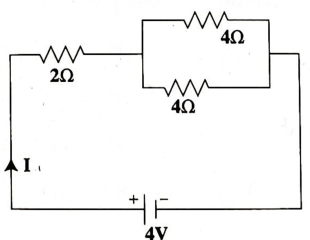
📝 Solution
Explanation: Resolving the parallel node and applying Ohm's law yields 1 Ampere.
Step-by-step:
Parallel resistance: $R_p = \frac{4 \times 4}{4 + 4} = 2\Omega$. Total resistance: $R_t = 2\Omega + 2\Omega = 4\Omega$. Current: $I = \frac{V}{R_t} = \frac{4}{4} = 1\text{A}$.
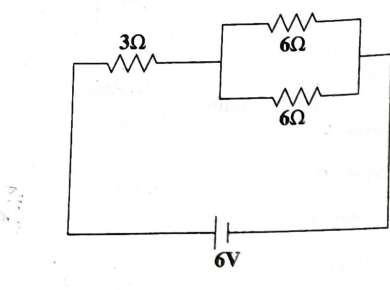
📝 Solution
Explanation: The $3\Omega$ series resistor consumes exactly half the 6V supply.
Step-by-step:
Parallel block: $R_p = \frac{6 \times 6}{6 + 6} = 3\Omega$. Total resistance: $R_t = 3\Omega + 3\Omega = 6\Omega$. Total Current: $I = \frac{6}{6} = 1\text{A}$. Voltage drop across series $3\Omega$: $V = 1\text{A} \times 3\Omega = 3\text{V}$.
📝 Solution
Explanation: A fuse is a thermal current device. It carries safe loads and melts under high short-circuit currents. It does not regulate voltage spikes.
Step-by-step:
A fuse is a deliberately inserted weak link in a circuit made of a low-melting-point alloy.
Statement (a): It is rated to carry the normal load current continuously without overheating or melting. (True)
Statement (b): If a short circuit or overload occurs, the excess current generates immense heat (), melting the wire and breaking the circuit. (True)
Statements (c) and (d): Fuses react purely to current, not voltage. They do not inherently detect or protect against undervoltage or overvoltage (unless the overvoltage directly causes a massive current spike, but that's an indirect effect. Relays and varistors handle voltage issues). (False)
📝 Solution
Explanation: Fuse "rating" is strictly defined as its safe continuous load capacity—the max current it can carry indefinitely without deteriorating.
Step-by-step:
When you buy a "5 Amp fuse," that rating does not mean it blows exactly at 5 Amps.
The rating indicates the safe continuous load. It is the maximum amount of current the fuse can carry indefinitely without getting hot enough to melt.
The fuse will actually burn/blow at a value slightly higher than its rated current (the fusing current).
📝 Solution
Explanation: Glass $\rightarrow$ Electronics. Kit Kat $\rightarrow$ Residential. HRC $\rightarrow$ Power grid. Raw wire $\rightarrow$ Emergency.
Step-by-step:
Glass cartridge fuse (a): Small, transparent fuses universally used inside delicate Electronic equipments (iii). (a iii)
Kit Kat Fuse (b): Semi-enclosed rewireable porcelain fuses traditionally used in Residential and small industrial boards (iv). (b iv)
HRC (High Rupturing Capacity) Fuse (c): Used for handling massive fault currents in high-tension Power distribution systems (ii). (c ii)
Fuse wire (d): The raw wire used for quick, fundamental Emergency protection (i). (d i)
Sequence: a-iii, b-iv, c-ii, d-i.
List - I (No. of turns): (a) $N_1 = N_2$, (b) $N_1 < N_2$, (c) $N_1 > N_2$, (d) Only one winding
List - II (Name of transformer): (i) Auto transformer, (ii) Isolation transformer, (iii) Step-up transformer, (iv) Step-down transformer
Codes:
📝 Solution
Explanation: Equal turns = Isolation. $N_1 < N_2$ = Step-up. $N_1 > N_2$ = Step- down. Single winding = Auto transformer.
Step-by-step:
(a): Voltage is neither stepped up nor down; it remains 1:1. This is strictly used to decouple circuits. It is an Isolation transformer (ii). (a ii)
(b): More turns on the secondary means the voltage increases. This is a Step-up transformer (iii). (b iii)
(c): Fewer turns on the secondary means the voltage decreases. This is a Step-down transformer (iv). (c iv)
Only one winding (d): A transformer that uses a single tapped continuous winding for both primary and secondary is an Auto transformer (i). (d i)
Sequence: a-ii, b-iii, c-iv, d-i.
📝 Solution
Explanation: An ideal machine model assumes 100% efficiency. "High winding resistance" contradicts an ideal assumption.
Step-by-step:
An "ideal" machine in physics is a hypothetical model assumed to be 100% efficient.
For an ideal transformer, we assume zero copper losses, meaning the coils have no winding resistance (a).
We assume all magnetic lines cut both coils perfectly, meaning no leakage flux (b).
We assume the core is perfect and dissipates no heat, meaning no iron/core losses (c).
High winding resistance (d) would create massive heat and voltage drops, which is the exact opposite of an ideal scenario.
📝 Solution
Explanation: Applying the fundamental turns ratio equation yields exactly 500 primary turns.
Step-by-step:
$$ \frac{V_1}{V_2} = \frac{N_1}{N_2} $$ $$ \frac{1000}{100} = \frac{N_1}{50} $$ $$ 10 \times 50 = N_1 \Rightarrow 500 $$
📝 Solution
Explanation: Faraday's Law of Mutual Electromagnetic Induction is the absolute foundational physics principle allowing transformers to transfer AC power.
Step-by-step:
A transformer works by passing alternating current through a primary coil, which creates a fluctuating magnetic field.
This fluctuating magnetic field passes through a secondary coil, inducing an electromotive force (voltage) in it.
The phenomenon of a changing magnetic field inducing a voltage in a circuit is strictly defined by Faraday's Law of Electromagnetic Induction.
📝 Solution
Explanation: Capacity indicates the total electrical charge stored over time, hence Ampere-hours.
Step-by-step:
The capacity of a battery tells you how much total electrical charge it can store and deliver over time.
It is calculated by multiplying the current (in Amperes) by the time (in hours) the battery can sustain that current before draining.
Therefore, the unit is Ampere-hours (AH) or milliampere-hours (mAh) for smaller batteries.
📝 Solution
Explanation: The Exclusive-OR (XOR) gate's defining functional characteristic is outputting True exclusively when input states do not match (inequality detector).
Step-by-step:
Construct the truth table for inputs A and B. "Inputs are different" means A=0, B=1 OR A=1, B=0.
We want the Output (Y) to be 1 (High) only in these scenarios.
The Exclusive-OR (XOR) gate truth table is: 0,0 0 0,1 1 1,0 1 1,1 0
It outputs High strictly when the inputs are unequal/different.
📝 Solution
Explanation: Sensors are purely passive data-gathering devices. Generating logic is for Controllers, and driving the plant is for Actuators.
Step-by-step:
In a control loop, Sensors act as the "eyes and ears". Their sole purpose is to detect and measure physical variables (temperature, pressure) and input signals (Statements b and c).
Sensors do not generate control logic or signals; that is the job of the Controller (like a PLC or PID). Therefore, Statement (d) is false.
Sensors do not drive the plant or physically control actions; that is the job of the Actuator (like a motor or valve). Therefore, Statement (a) is false.
📝 Solution
Explanation: "Programmable Logic Controller" is the globally standardized expansion of the industrial automation acronym PLC.
Step-by-step:
In industrial control systems, a ruggedized computer used to automate manufacturing processes (like assembly lines or robotic devices) is required.
This device is called a Programmable Logic Controller.
"Programmable" because its code can be changed, "Logic" because it operates on Boolean and sequential logic operations, and "Controller" because it controls output machinery.
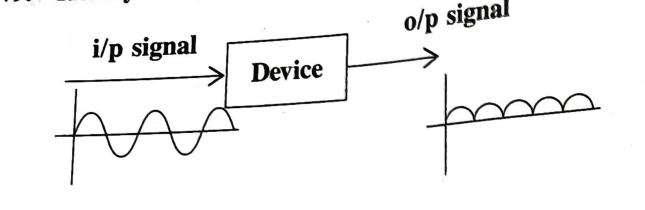
📝 Solution
Explanation: A Rectifier is the exact electronic device used to convert bi-directional AC into uni-directional pulsating DC.
Step-by-step:
The input waveform is Alternating Current (AC), swinging above and below the zero axis.
The output waveform is Direct Current (DC), with the negative half-cycles flipped to positive (specifically, full-wave rectified DC).
The process of converting AC to DC is called rectification.
Therefore, the device is a Rectifier.

📝 Solution
Explanation: Integrating a CPU alongside memory, timers, and I/O ports into one unified integrated circuit block defines a Microcontroller.
Step-by-step:
A Microprocessor (Option 1) consists purely of the CPU (ALU + Control Unit) on a single chip. It requires external chips for RAM, ROM, and I/O ports.
A Microcontroller (Option 4) is specifically designed as an entire "computer on a chip." It integrates the CPU, Memory (RAM/ROM), Timers, and I/O ports all onto one single integrated circuit die.
The diagram explicitly shows all these peripheral components packed together inside one single unified block framework.
Section 9: Project Management
📝 Solution
Explanation: Projects have an end date, whereas Operations are continuous, repetitive daily tasks required to sustain a business.
Step-by-step:
A Project is explicitly defined as a "temporary endeavor undertaken to create a unique product, service, or result." It has a strict start and end date.
An Operation, by contrast, is the day-to-day work required to sustain a business. It is repetitive and continuous (e.g., manufacturing the same car every day, running a help desk).
Therefore, Operation maps to an "Ongoing work effort".
📝 Solution
Explanation: Consultants act as external subject matter experts, providing specialized strategic direction without managing daily administrative grind.
Step-by-step:
A Project Manager handles the day-to-day execution, administration, and team management.
However, high-level guidance, specialized expertise, and strategic direction (often from outside the core execution team) are provided by Consultants or Project Advisors.
📝 Solution
Explanation: Logically pairs categories (Sector $\rightarrow$ Industrial, Ownership $\rightarrow$ Private, etc.).
Step-by-step:
Basis of sector (a): Defines what industry the project is in. Matches "Industrial project" (iii). (a iii)
Basis of ownership (b): Defines who owns it (Government vs Private). Matches "Private sector project" (i). (b i)
Basis of dependency (c): Defines if the project relies on others. Matches "Dependent project" (iv). (c iv)
Basis of risk (d): Defines the hazard level. Matches "High risk project" (ii). (d ii)
The sequence is a-iii, b-i, c-iv, d-ii.
📝 Solution
Explanation: Rework is a symptom of failure or poor planning; believing it is an expected management phase is a misconception.
Step-by-step:
Planning, Scheduling, and Controlling are the three absolute core pillars of formal Project Management.
A common misconception by untrained individuals is that project management involves constant trial-and-error or that "rework" is just a normal phase of getting things done.
In reality, effective project management is designed to eliminate rework by planning properly the first time.
📝 Solution
Explanation: The WBS, PEP, and PPM form the exact textbook triad required for structuring a project work system.
Step-by-step:
To systematically execute a project, three major documents are designed:
WBS (Work Breakdown Structure): Breaks the project into manageable tasks.
PEP (Project Execution Plan): Outlines how these tasks will be done.
PPM (Project Procedure Manual): Sets the rules, standards, and compliance procedures for doing them.
📝 Solution
Explanation: All four represent critical, documented prerequisites for ensuring execution success without bottlenecks.
Step-by-step:
Adequate formulation: A well-defined scope is mandatory.
Sound project organization: A good team hierarchy is mandatory.
Proper planning: WBS and scheduling are mandatory.
Advance Action: Securing permits, initial funding, or long-lead materials before the official start prevents bottlenecks and is highly recommended.
📝 Solution
Explanation: Tracking and logging daily physical project health on-site is a core operational duty of the Project Manager.
Step-by-step:
A Project Diary (or project log) records daily occurrences, weather conditions, disputes, progress, and site conditions.
The person on the ground responsible for overseeing the daily execution and ensuring all events are legally and practically recorded is the Project Manager (or site manager acting on their behalf).
📝 Solution
Explanation: Maps organizational roles perfectly to their standard textbook PM definitions.
Step-by-step:
Initial project team (a): The pioneers who conceive the idea before it's fully funded (iii). (a iii)
Core project team (b): The people officially hired to design, execute, and manage the project (iv). (b iv)
Project Advisors (c): Experts who provide feedback and counseling (ii). (c ii)
Project stakeholders (d): Anyone with an interest, especially those who invested in it (i). (d i)
The sequence is a-iii, b-iv, c-ii, d-i.
📝 Solution
Explanation: Because it relies on percentage probability models, decision tree analysis is strictly used for events characterized by uncertainty.
Step-by-step:
A Decision Tree is a flowchart-like diagram used to evaluate different courses of action.
Each branch represents a possible outcome, assigned a probability percentage and a financial impact.
Because probabilities are involved, decision trees are strictly used when the future is unknown—i.e., evaluating Uncertainty. If an outcome was certain, you wouldn't need a probability tree.
📝 Solution
Explanation: CPM stands for Critical Path Method.
Step-by-step:
CPM is the most widely used mathematical algorithm for scheduling a set of project activities.
It stands for Critical Path Method.
📝 Solution
Explanation: The physical "longest" continuous path mathematically bounds the minimum (shortest possible) completion time of the entire project.
Step-by-step:
To finish a project, all paths in the network diagram must be completed.
The path that takes the maximum amount of time (the longest sequence) dictates the timeline of the whole project. You cannot finish earlier than your longest path allows.
Therefore, this longest path determines the shortest possible duration in which the entire project can be successfully completed.
📝 Solution
Explanation: Pairs each specific management domain to its corresponding operational tracking metric.
Step-by-step:
Resource plan (a): Deals with personnel and equipment. Matches "Type of labour" (iv). (a iv)
Financial plan (b): Deals with budgets. Matches "Labour cost" (iii). (b iii)
Quality plan (c): Ensures the product meets specifications. Matches "Customer requirements" (ii). (c ii)
Risk plan (d): Deals with hazards and uncertainties. Matches "Human risk" (safety/turnover) (i). (d i)
The sequence is a-iv, b-iii, c-ii, d-i.
📝 Solution
Explanation: A successful project relies on documented plans (formal) balanced with agile, ad-hoc team coordination (informal).
Step-by-step:
Formal planning includes documented schedules, WBS, budgeted baselines, and risk registers.
Informal planning includes hallway conversations, rapid whiteboarding sessions, and daily ad-hoc problem solving by the team.
Successful projects require a blend of both; formal plans provide the structure, informal plans provide agility.
📝 Solution
Explanation: Exact math takes too long for large-scale constraint scheduling, so heuristic (approximate) programming algorithms are used.
Step-by-step:
Linear programming provides mathematical optimization for complex, multi-constraint problems.
For "Large scale scheduling" where resources are heavily constrained, mathematically calculating the perfect optimal schedule (using exact algorithms) takes too long (NP-hard problem).
Therefore, software uses Heuristic programming (rules of thumb / educated algorithms) to find a "good enough" workable schedule quickly.
📝 Solution
Explanation: Network technique maps interrelations; design is the blueprint; estimating time targets it; Gantt visually tracks it.
Step-by-step:
Network technique (b): Maps out predecessor/successor logic. Matches "Interrelation activities" (iii). (b iii)
Project design (c): The overall plan. Matches "Blue print for action-oriented activity" (iv). (c iv)
Looking at (a) and (d) between (i) and (ii):
Time Estimate (d): The act of determining duration fixes/sets the target. (d i)
Gantt chart (a): Visually represents the estimated time on a calendar. (a ii).
Sequence: a-ii, b-iii, c-iv, d-i.
📝 Solution
Explanation: Both top-down direction and bottom-up incentives are recognized organizational management strategies.
Step-by-step:
Planning by direction: A top-down approach where managers dictate exactly what, when, and how tasks will be done.
Planning by incentive: A participative approach where teams are given goals and financial/recognition incentives to figure out the best way to achieve the plan themselves.
Both are established methodologies taught in industrial management.
📝 Solution
Explanation: "Post" designates an audit done after the final commissioning phase is officially handed over.
Step-by-step:
"Commissioning" is the act of turning the finished project (like a power plant) on and handing it over to the owner.
Any audit conducted after this phase is completed is logically referred to as a Post-audit (or Post-Implementation Review).
It aims to see if the project actually delivered the promised ROI.
📝 Solution
Explanation: PERT utilizes three probabilistic time estimates to specifically handle highly uncertain, non-repetitive task lengths.
Step-by-step:
CPM (Critical Path Method) uses a single, deterministic time estimate for each task. It is used for certain, repetitive projects (like building a house).
PERT (Program Evaluation and Review Technique) uses three probabilistic time estimates (Optimistic, Pessimistic, Most Likely). It was designed by the US Navy for R&D projects where task durations are highly uncertain.
Section 10: IoT
📝 Solution
Explanation: IOT physically connects sensors to internet (Smart farming). Augmented reality is heavy in Gaming. Cloud hosts web SaaS like Gmail.
Step-by-step:
IOT (Internet of Things) (a): Connecting physical sensors to the internet. Matches "Smart farming" (ii), where soil sensors automate irrigation. (a ii)
Augmented reality (b): Overlaying digital images on the real world. Heavily used in "Gaming" (iii) (e.g., Pokemon Go). (b iii)
Cloud technology (c): Remote servers hosting applications. "Gmail account" (i) is a primary SaaS cloud example. (c i)
Sequence: a-ii, b-iii, c-i.
📝 Solution
Explanation: The critical path is defined as the path yielding the highest numerical duration sum.
Step-by-step:
The critical path is defined as the path with the longest total duration.
Trace all possible routes from Start (A) to Finish (E) following the directional arrows:
Path 1: A B E = 10 + 8 = 18
Path 2: A B C E = 10 + 5 + 6 = 21
Path 3: A C E = 12 + 6 = 18
Path 4: A D E = 9 + 8 = 17 (Note: There is no arrow from C to B, only B to C, so Option 4 is physically impossible).
The highest total duration is 21.
Answer Key
| Q.No | Ans | Q.No | Ans | Q.No | Ans | Q.No | Ans | Q.No | Ans |
|---|---|---|---|---|---|---|---|---|---|
| 1 | (3) | 21 | (2) | 41 | (2) | 61 | (4) | 81 | (1) |
| 2 | (3) | 22 | (2) | 42 | (4) | 62 | (4) | 82 | (3) |
| 3 | (1) | 23 | (1) | 43 | (2) | 63 | (4) | 83 | (1) |
| 4 | (2) | 24 | (1) | 44 | (4) | 64 | (2) | 84 | (2) |
| 5 | (3) | 25 | (4) | 45 | (2) | 65 | (1) | 85 | (1) |
| 6 | (3) | 26 | (1) | 46 | (3) | 66 | (2) | 86 | (4) |
| 7 | (2) | 27 | (2) | 47 | (2) | 67 | (2) | 87 | (3) |
| 8 | (4) | 28 | (1) | 48 | (2) | 68 | (3) | 88 | (3) |
| 9 | (2) | 29 | (4) | 49 | (2) | 69 | (3) | 89 | (1) |
| 10 | (3) | 30 | (3) | 50 | (3) | 70 | (2) | 90 | (2) |
| 11 | (2) | 31 | (2) | 51 | (3) | 71 | (1) | 91 | (1) |
| 12 | (1) | 32 | (2) | 52 | (1) | 72 | (1) | 92 | (3) |
| 13 | (3) | 33 | (3) | 53 | (4) | 73 | (2) | 93 | (3) |
| 14 | (3) | 34 | (3) | 54 | (4) | 74 | (2) | 94 | (4) |
| 15 | (2) | 35 | (3) | 55 | (3) | 75 | (3) | 95 | (2) |
| 16 | (1) | 36 | (1) | 56 | (2) | 76 | (3) | 96 | (3) |
| 17 | (1) | 37 | (2) | 57 | (2) | 77 | (2) | 97 | (3) |
| 18 | (2) | 38 | (3) | 58 | (3) | 78 | (2) | 98 | (2) |
| 19 | (4) | 39 | (3) | 59 | (3) | 79 | (2) | 99 | (1) |
| 20 | (2) | 40 | (2) | 60 | (4) | 80 | (4) | 100 | (2) |